Most recurring flight department friction is not caused by poor communication. It is caused by unclear ownership, mismatched authority, and functions that were never explicitly assigned.
Every experienced Director of Aviation has lived this moment. A maintenance issue sits unresolved for three days because two people each assumed the other was handling it. A scheduling conflict escalates to the Director's desk even though it should have been resolved at the crew scheduling level. A safety concern gets discussed in three separate meetings and somehow never gets closed out.
None of this looks like a crisis. It looks like Tuesday.
Capable people are working hard. Everyone means well. And yet the same problems keep resurfacing in slightly different forms. Decisions take longer than they should. Escalations pile up on the Director of Aviation's desk, many of them routine matters that never needed to reach that level. Meetings multiply. Strategic work gets pushed to the following week, then the week after that.
If this sounds familiar, the department does not have a communication problem. It has a structure problem.
Communication is the symptom, not the disease
Most flight departments diagnose friction as a communication failure. Leadership responds with more meetings, more status updates, more reminders to "loop everyone in." This rarely works, because communication cannot substitute for structure. It can only work around the gaps that poor structure creates.
An organizational chart shows who reports to whom. It tells you titles and reporting lines. It does not tell you who owns a result, who has authority to make a given decision, or what outcome a function is responsible for producing.
An Accountability Chart is different. It defines the functions the department must perform, the outcomes each function owes the organization, the authority attached to that function, and the single person accountable for it. Titles are secondary. Ownership is the point.
This distinction matters because capable people are very good at compensating for weak structure. A strong chief pilot will quietly absorb ambiguity around crew scheduling authority. A conscientious maintenance lead will keep informal tabs on vendor performance even though nobody formally assigned that to him. The department functions, for a while, on the goodwill and initiative of a few people who fill gaps nobody documented.
That compensation is exactly what hides the problem. It works until someone leaves, gets promoted, or simply reaches capacity. Then the gap becomes visible, usually at the worst possible time, and leadership is left wondering how something so basic never got assigned to anyone.
Building the chart from the work, not the org
The right way to build an Accountability Chart starts with the work the department must perform, not the people currently on staff. This is a meaningful shift in sequence, and it is where most departments go wrong. They start with the people they have and try to divide responsibilities among them. That approach locks in whatever gaps and overlaps already exist.
The correct sequence runs in four steps.
First, identify the major functions the flight department must perform regardless of who is on payroll. Flight operations, maintenance, scheduling, safety, and finance do not disappear because a role is vacant. The function still needs to happen.
Second, define the outcomes each function must deliver. Not tasks. Outcomes. Maintenance is not "responsible for wrenching on the airplane." Maintenance is responsible for an airworthy, reliable, cost-controlled aircraft.
Third, establish the decision authority that comes with each function. If a function is accountable for an outcome, the person in that seat needs the authority to make the decisions that produce it. Accountability without authority is just blame waiting to happen.
Fourth, and only then, assign the person accountable for each seat. One person can hold more than one seat, particularly in smaller departments. What matters is that every seat has exactly one name attached to it, and every name knows exactly which seats they hold.
The department does not necessarily need more people. It needs clearer ownership.
This is the foundation of the Flight Department Operating System, or FDOS. FDOS draws from multiple proven management disciplines and applies them specifically to the unique requirements of flight department leadership, governance, accountability, performance management, and execution. The Accountability Chart is one of its foundational tools, and it works the same way in a single-aircraft department as it does in a fleet of a dozen. FDOS separates functions from people on purpose. It does not assume every department needs more layers of management. It assumes every department needs clarity about who owns what.
The standard FDOS Accountability Chart
What follows is the standard reference model for a professionally managed Part 91 flight department. Treat it as a starting point, not a mandate. Fleet size, staffing levels, mission profile, operating complexity, corporate structure, and the balance of internal versus outsourced resources will all shape how this gets adapted for a specific operation. A single-aircraft department with one pilot wearing three hats will apply this differently than a ten-aircraft fleet with a full staff. The functions stay the same. The names attached to them will not.
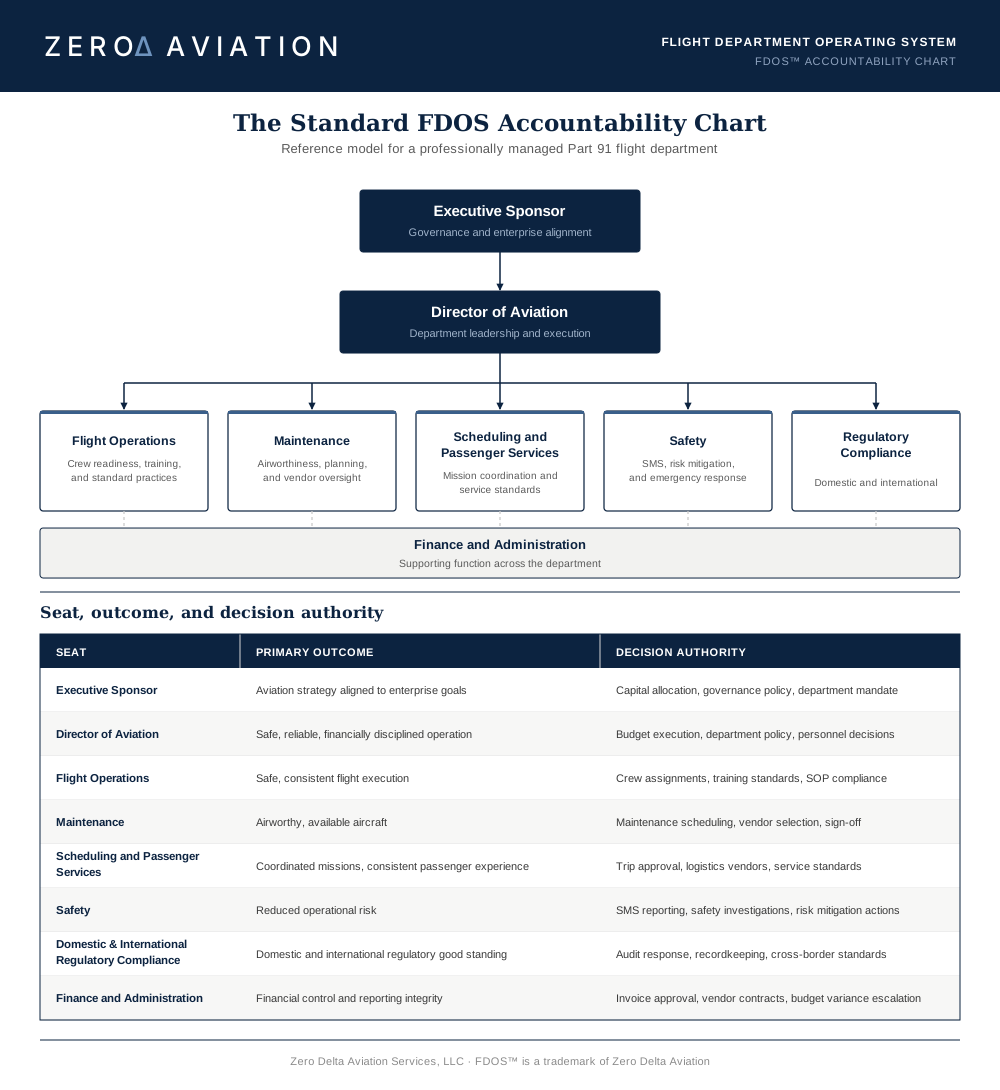
Executive Sponsor
Purpose: Connect the flight department to enterprise priorities, governance, capital allocation, and risk expectations.
- Aviation strategy and business objectives
- Governance and risk expectations
- Major capital and policy decisions
- Enterprise alignment
- Relationship with the Director of Aviation
The Executive Sponsor is not the department's operator. This person sets the boundaries the department operates within and ensures aviation stays aligned with the broader enterprise. Departments without a clearly identified Executive Sponsor often drift, because nobody above the Director of Aviation is accountable for connecting aviation decisions to enterprise priorities.
Director of Aviation
Purpose: Lead the department and deliver safe, reliable, financially disciplined aviation services.
- Department strategy and annual planning
- Safety and regulatory performance
- Budget and financial management
- Leadership and organizational performance
- Executive communication and reporting
This is the seat where accountability concentrates. It is also the seat most likely to absorb work that belongs elsewhere, because the Director of Aviation is the person everyone defaults to when a function's ownership is unclear. A well-built Accountability Chart reduces that default behavior by giving every function a clear owner below the Director.
Flight Operations
Purpose: Ensure flight activity is conducted safely, consistently, and professionally.
- Pilot staffing and readiness
- Crew scheduling
- Training and qualification
- Standard operating practices
- Pilot performance and development
Maintenance
Purpose: Maintain safe, compliant, reliable, and cost-effective aircraft.
- Airworthiness and compliance
- Maintenance planning
- Aircraft availability
- Vendor oversight
- Maintenance budget performance
Scheduling and Passenger Services
Purpose: Coordinate missions and deliver a consistent passenger experience.
- Trip intake and mission coordination
- Aircraft and crew scheduling
- Passenger communication
- Catering, ground transportation, and logistics
- Trip records and service standards
Safety
Purpose: Identify, monitor, and reduce operational risk.
- SMS administration and safety promotion
- Risk identification and mitigation
- Safety reporting and investigations
- Emergency response planning
- Safety culture and training
Domestic and International Regulatory Compliance
Purpose: Keep the department in good standing with every regulatory authority it operates under, domestic and international.
- FAR Part 91 compliance
- International and bilateral regulatory requirements
- Audits and regulatory findings
- Recordkeeping and documentation
- Export, customs, and cross-border documentation
Departments that fly only domestically and rarely deal with international regulatory exposure often combine this seat with Safety. Departments with regular international operations, customs and permit requirements, or bilateral aviation safety agreement exposure tend to need it as its own seat, since the accountabilities are meaningfully different from day-to-day risk management. This is the kind of adaptation the chart is built to absorb.
Finance and Administration
Purpose: Provide financial control, administrative discipline, and reliable management information.
- Budget preparation and variance analysis
- Invoice review and cost allocation
- Vendor and contract administration
- Records and administrative controls
- KPI and executive reporting support
Finance and Administration sits across the department rather than beneath it because it supports every function. Maintenance needs financial controls. Flight operations needs budget discipline. Scheduling needs administrative support. This function touches all of them without owning the operational outcomes of any of them.
Five rules for making the chart work
An Accountability Chart is not a job description, and it fails when treated like one. Job descriptions list tasks. This chart assigns outcomes and authority. Five principles keep it functioning as intended.
Define seats before assigning names. If you start with the people on staff today, you will build the chart around their existing habits rather than around what the department actually needs. Define the function first. Attach the name second.
Keep accountabilities at the right level. A seat with forty bullet points is not a seat, it is a task list. Five major accountabilities per seat is enough to describe an outcome without descending into daily task management.
Give each outcome one owner.
Shared participation is healthy. Shared accountability usually means nobody owns the result.
Multiple people can contribute to an outcome. Only one person can be accountable for it.
Match authority to responsibility. If someone is accountable for aircraft availability, that person needs real authority over maintenance planning and vendor decisions. Accountability without matching authority creates frustration and, eventually, finger pointing when things go wrong.
Review the structure as the operation changes. A chart built for a single aircraft with two pilots will not fit a department that has grown to three aircraft and a maintenance program. The chart is a living document, not a one-time exercise.
The test of a working chart
A useful Accountability Chart should allow every employee in the department to answer three questions without hesitation.
What results do I own? What decisions can I make on my own authority? Where do I go when an issue crosses functional lines?
Leadership should be able to look at the chart and answer a parallel set of questions. Is every critical function owned by someone? Are two seats competing for the same authority? Are responsibilities falling between seats because nobody claimed them? Is the Director of Aviation carrying accountabilities that belong to someone else? Does the person in each seat understand the role, want the role, and have the capacity to perform it well?
These questions surface problems long before they show up as a missed maintenance deadline or a scheduling conflict that reaches the C-suite.
When functions are clearly defined and accountability is assigned, the department becomes less dependent on informal coordination and individual heroics. Decisions improve. Issues move faster. People understand where they have authority. The Director of Aviation can spend more time leading the organization and less time refereeing it. The same problems stop coming back.
That is the value of the Accountability Chart.
Brief Answers
Is an Accountability Chart the same thing as an org chart?
No. An org chart shows titles and reporting lines. An Accountability Chart shows the functions the department must perform, the outcome each function owes the organization, the decision authority attached to it, and the single person accountable for it. A department can have a clean org chart and still have no real accountability structure underneath it.
How many seats does a flight department actually need?
The standard reference model above has seven functional seats plus the Executive Sponsor. A single-aircraft department may consolidate several of these into one or two people. A larger or more complex operation, particularly one with regular international flying, may need every seat filled by a different person. The number of seats should track the work that has to get done, not a fixed staffing target.
Can one person hold more than one seat?
Yes. Seat consolidation is normal in smaller departments. What matters is that every seat stays visible on the chart even when one person holds several, so nothing goes unassigned simply because there was no dedicated headcount for it.
Does the Accountability Chart replace job descriptions?
No. A job description lists tasks and duties. The Accountability Chart assigns outcomes and decision authority at a higher level. The two documents serve different purposes and can coexist.
How often should the chart be reviewed?
Review it whenever the operation changes materially: a fleet addition, a headcount change, a new mission type, or a shift in regulatory exposure such as taking on regular international flying. Outside of a triggering event, an annual review alongside strategic planning is a reasonable baseline.
What if the Director of Aviation is currently doing all of this alone?
That is common in smaller departments and is not itself a problem. The chart still matters, because it shows which seats the Director is filling personally and which ones should move to someone else as the department grows. Without the chart, that transition tends to happen late, under pressure, rather than deliberately.